Loading...
Welcome to visit Journal of Dairy Science and Technology!
Share:
中国科技核心期刊
ISSN 1671-5187
CN 31-1881/S
Toggle navigation
Home
About Journal
Editorial Board
Journal Online
Current Issue
Just Accepted
Archive
Most Read Articles
Most Download Articles
Most Cited Articles
E-mail Alert
Instruction
Subscription
Contact Us
中文
Table of Content
01 May 2026, Volume 49 Issue 3
Previous Issue
Basic Research
Effects of Oligosaccharides from Different Milk Sources on the Immune Activity of RAW264.7 Macrophages
WANG Ziye, ZHU Mengqing, XUE Xiaoqian, JIANG Yanfei, DAI Zixin, LU Yu
2026, 49(3): 1-10. DOI:
10.7506/rykxyjs1671-5187-20260205-010
Asbtract
(
)
HTML
(
)
PDF
(3438KB) (
)
Related Articles
|
Metrics
Human milk free oligosaccharides (HMOs) play a critical role in the early development of the infant immune system. Goat milk free oligosaccharides (GMOs) exhibit greater structural and quantitative similarity to HMOs compared with bovine milk free oligosaccharides (BMOs). In this study, neutral and acidic free oligosaccharide fractions were efficiently prepared from human, goat, and bovine milk using DEAE-52 weak anion-exchange cellulose chromatography combined with graphitized carbon solid-phase extraction. The immunomodulatory activities of these fractions and their underlying mechanisms were comparatively investigated in RAW264.7 macrophages. The results showed that all oligosaccharide fractions exhibited immunomodulatory activity. Notably, human milk sialylated free oligosaccharides (SHMOs) and goat milk sialylated free oligosaccharides (SGMOs) demonstrated stronger activity than bovine milk sialylated free oligosaccharides (SBMOs), potentially mediated through upregulation of the mitogen-activated protein kinases signaling pathway. Finally, online liquid chromatography-mass spectrometry was employed for qualitative and quantitative comparative profiling of SHMOs, SGMOs, and SBMOs. The results revealed that SGMOs shared greater structural homology with SHMOs, which may account for their enhanced immunomodulatory potency.
Whole Genome Sequencing and Safety Evaluation of Lactiplantibacillus plantarum SC-1
WU Zhongling
2026, 49(3): 11-16. DOI:
10.7506/rykxyjs1671-5187-20260220-015
Asbtract
(
)
HTML
(
)
PDF
(2503KB) (
)
Related Articles
|
Metrics
Lactiplantibacillus plantarum SC-1, a strain able to promote the production of ergosterol by Monascus isolated from naturally fermented Chinese sauerkraut, was evaluated for genetic characteristics and application safety. Whole genome sequencing and Kyoto Encyclopedia of Genes and Genomes (KEGG) and gene ontology (GO) annotation showed that the functional genes of strain SC-1 are involved in pathways including amino acid synthesis, carbon metabolism, genetic information regulation, and environmental stress response. The carbohydrate-active enzymes (CAZy) of this strain were predominantly glycoside hydrolases and glycosyltransferases, indicating that the strain can metabolize carbohydrates. Acid and bile salt tolerance assays demonstrated that the survival rate of SC-1 was (68.89 ± 3.91)% in an acidic environment (pH 2.5) and (50.30 ± 4.25)% at 0.3% (m/m) bile salt content, respectively. In addition, SC-1 exhibited γ-hemolysis (non-hemolytic activity) and it was sensitive to common antibiotics such as penicillin but showed resistance to several aminoglycoside antibiotics. SC-1 had no significant virulence and its resistance genes posed no transfer risk.
Biotechnology
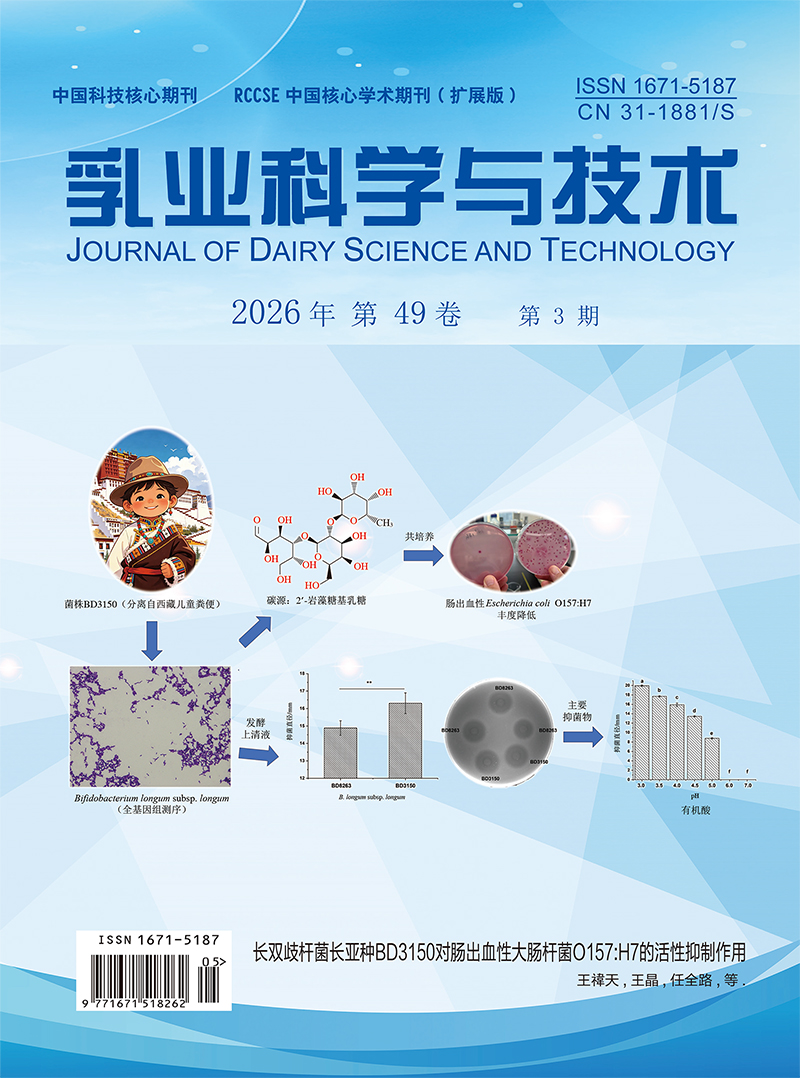
Inhibitory Effect of Bifidobacterium longum subsp. longum BD3150 on Enterohemorrhagic Escherichia coli O157:H7
WANG Yitian, WANG Jing, REN Quanlu, WU Zhengjun
2026, 49(3): 17-24. DOI:
10.7506/rykxyjs1671-5187-20260220-014
Asbtract
(
)
HTML
(
)
PDF
(2722KB) (
)
Related Articles
|
Metrics
This study systematically investigated the inhibitory activity of Bifidobacterium longum subsp. longum BD3150 and its cell-free supernatant (CFS) against enterohemorrhagic Escherichia coli O157:H7 (EHEC O157) using the co-culture assay and the agar diffusion method. When 2’-fucosyllactose (2’-FL) served as the sole carbon source, the relative abundance of EHEC O157 after 6 and 18 h of co-culture with B. longum subsp. longum BD3150 was 72.3% and 67.8%, respectively, which was lower than that observed using glucose as the sole carbon source. The antibacterial activity of CFS from B. longum subsp. longum BD3150, cultivated in modified de Man-Rogosa-Sharpe (MRS) medium, was further characterized. The optimum culture conditions were found to be an inoculation size of 3.0%, incubation temperature of 37 ℃, and incubation time of 36 h. A negative correlation was observed between the diameter of the inhibition zone and the pH of the CFS. Furthermore, by adjusting the pH of the CFS and performing centrifugal ultrafiltration (3 kDa, 7 500 × g for 25 min), it was revealed that the inhibitory activity against EHEC O157 was attributed to organic acids.
Processing technology
Formulation Optimization and Quality Analysis of Oat-Barley Grass Powder Composite Yogurt
BAI Yanxiao, WANG Yitong, ZHU Jing
2026, 49(3): 25-32. DOI:
10.7506/rykxyjs1671-5187-20260205-009
Asbtract
(
)
HTML
(
)
PDF
(2730KB) (
)
Related Articles
|
Metrics
Plant-based yogurt, fermented by a lactic acid bacterial starter culture, was developed from barley grass powder and oat powder as the main raw materials, supplemented with soy protein isolate (SPI) and sucrose. Single-factor and orthogonal array experiments were conducted to investigate the effects of barley grass powder addition, oat powder-to-water ratio, starter culture addition, and SPI addition on the acidity and sensory score of the yogurt, and the optimal formulation was determined. The physicochemical and microbiological parameters, water-holding capacity, texture properties, bioactive constituents and antioxidant capacity were measured. The results showed that under the optimal conditions of 1.5% barley grass powder addition, 1:14 (g/mL) oat powder-to-water ratio, 0.2% starter culture addition, and 1.5% SPI addition, the yogurt exhibited a sensory score of 92.82, acidity of 73.25 °T, pH value of 4.38, water-holding capacity of 68.42%, viable bacterial count of 3.15 × 10⁷ CFU/g, total flavonoid content of 46.3 mg/100 g, total phenol content of 81.2 mg/100 g, 1,1-diphenyl-2-picrylhydrazyl radical scavenging rate of 76.2%, hydroxyl radical scavenging rate of 74.5%, and ferric reducing antioxidant power of 71.5 mmol/L. The product demonstrated a uniform texture, smooth and delicate mouthfeel, harmonious flavor, and no suspended particles, and possessed the distinctive flavors of barley grass and oats. All quality indices complied with the relevant national standards.
Analysis & Detection
Determination of Lactoferrin in Dairy Products: A Comparative Study of Ultra-high Performance Liquid Chromatography with Ultraviolet Detection and Liquid Chromatography-Tandem Mass Spectrometry
WU Lunwei, LI Peizhen, DUAN Guoxia, ZHANG Lijia, TANG Shuo, LIU Lijun, WU Xiaoli, GONG Huili, CHEN Jing, LIU Chunxia
2026, 49(3): 33-40. DOI:
10.7506/rykxyjs1671-5187-20260127-006
Asbtract
(
)
HTML
(
)
PDF
(2185KB) (
)
Related Articles
|
Metrics
Lactoferrin, a key functional protein in dairy products, serves the dual functions of nutritional supply and physiological regulation. Its accurate quantification serves as a critical link in the quality control and quality evaluation of dairy products. This study systematically compared the detection performances, operational procedures and application scopes of two mainstream analytical techniques for lactoferrin determination in dairy products, namely ultra-high performance liquid chromatography with ultraviolet detection (UPLC-UV) and liquid chromatography-tandem mass spectrometry (LC-MS/MS). The UPLC-UV method adopted a C4 column for chromatographic separation, with 280 nm set as the characteristic detection wavelength. The pretreatment was accomplished by phosphate buffer extraction followed by heparin affinity column purification, and quantification was performed using the external standard calibration curve method. This method featured high instrument availability, with spiked recoveries ranging from 82.32% to 98.07%, a limit of quantification (LOQ) of 1 mg/100 g, and a correlation coefficient above 0.999, indicating good reproducibility. It was suitable for routine testing of batch samples in dairy enterprises. Nevertheless, it presented moderate anti-matrix interference capability and insufficient sensitivity for the detection of trace lactoferrin in complex matrices, and was incapable of determining denatured lactoferrin. In contrast, the LC-MS/MS method involved sample dissolution and enzymatic hydrolysis to screen for signature peptides. Quantification was performed in multiple reaction monitoring (MRM) mode using the internal standard calibration curve method. It possessed excellent anti-matrix interference capacity, with a LOQ as low as 0.2 mg/100 g, and enabled the determination of total lactoferrin. This approach was applicable to the detection of low-abundance lactoferrin in complex matrix samples such as infant formula powder and high-temperature sterilized milk. However, it was constrained by high instrument cost, insufficient supporting reference materials, cumbersome operation and relatively low detection efficiency.
Identification of Water Adulteration in Non-bovine Milks Using Near-Infrared Spectroscopy Combined with a Convolutional Neural Network Model
SHAO Zixiang, Torkun·MAMET
2026, 49(3): 41-47. DOI:
10.7506/rykxyjs1671-5187-20260205-011
Asbtract
(
)
HTML
(
)
PDF
(2290KB) (
)
Related Articles
|
Metrics
To address the increasingly severe issue of water adulteration in the non-bovine milks market, this study proposed a rapid, non-destructive method for identifying multiple types of adulterated non-bovine milks based on portable nearinfrared spectroscopy combined with convolutional neural networks (CNN). Spectral data were collected for four types of non-bovine milks, camel, horse, donkey, and yak milks, as well as samples of these milks diluted with water at varying concentrations (2%–80%, V/V). We compared the effects of standard normal variate transformation (SNV) and Savitzky- Golay filter smoothing preprocessing on the performance of partial least squares discriminant analysis (PLS-DA) and CNN models. The results showed that non-bovine milks exhibited significant characteristic absorption of moisture at 6 882 and 10 200 cm–1. The CNN model with SNV preprocessing achieved the best performance, with a classification accuracy of 98.71% on the test set, and its precision and recall were superior to those of traditional PLS-DA model. This model not only accurately distinguished between milks from different species but also exhibited high sensitivity in detecting water adulteration as low as 2%. The present study demonstrates that the discrimination system based on a portable near-infrared spectrometer and CNN can effectively reduce matrix interference in minor species milks.
Determination of Six Quinolone Residues in Milk by High Performance Liquid Chromatography-Tandem Mass Spectrometry Coupled with PRIME HLB Column Purification Method
YIN Xue
2026, 49(3): 48-54. DOI:
10.7506/rykxyjs1671-5187-20251230-093
Asbtract
(
)
HTML
(
)
PDF
(2135KB) (
)
Related Articles
|
Metrics
An analytical method based on purification using a PRIME HLB column coupled with high performance liquid chromatography-tandem mass spectrometry (HPLC-MS/MS) was established for the simultaneous determination of six quinolone residues—ciprofloxacin, enrofloxacin, norfloxacin, sarafloxacin, ofloxacin, and pefloxacin—in bovine milk. The proposed procedure innovatively employs 0.1 mol/L ethylenediaminetetraacetic acid-Mcllvaine buffer combined with 1% formic acid-acetonitrile (2:8, V/V) as the extraction system, followed by one-step purification using a PRIME HLB column. This approach markedly simplifies conventional solid-phase extraction and reduces the sample preparation time. The purified sample was concentrated by nitrogen blowing, reconstituted, and filtered through a membrane. The separation was achieved on a C18 column (3.0 mm × 100 mm, 2.7 μm), and the HPLC-MS/MS system was operated in positive ion mode with multiple reaction monitoring. The results showed that the limits of detection for the six quinolones ranged from 0.04 to 0.10 μg/kg, and the limits of quantification from 0.13 to 0.33 μg/kg. Matrix-matched standard curves were adopted for quantification by the external standard method, which exhibited good linearity over the concentration range of 2–100 μg/L with a correlation coefficient ≥ 0.996 1. Average recoveries from milk samples spiked at concentration levels of 2–50 μg/kg ranged from 85.5% to 106.5% with relative standard deviations ranging from 1.60% to 4.75% (n = 6). This method features rapid operation, accurate results, and high precision. It provides reliable technical support for the highthroughput screening of quinolone residues in large batches of bovine milk.
Reviews
Research Progress on the Reduction of Cow’s Milk Allergens Using Cold Plasma Technology
WEN Zimo, SUN Jiayu, ZHANG Le, WANG Li, PAN Daodong, DU Lihui
2026, 49(3): 55-65. DOI:
10.7506/rykxyjs1671-5187-20260126-005
Asbtract
(
)
PDF
(1959KB) (
)
Related Articles
|
Metrics
Cow’s milk is rich in high-quality protein, but cow’s milk protein allergy is one of the major food allergies posing a serious threat to infant health. Therefore, developing efficient and safe cow’s milk desensitization technology (methods that destroy or mask the antigenic epitopes of allergenic proteins through physical, chemical, or biological means, thereby reducing their ability to trigger allergic reactions) is crucial for producing hypoallergenic dairy products. In recent years, cold plasma has emerged as a novel non-thermal processing technology, demonstrating significant potential in reducing food allergenicity due to its unique advantages in modifying protein structure. This paper first reviews the major allergens in cow’s milk, the sensitization mechanisms of these allergens, and the limitations of existing desensitization technologies. It then focuses on the core principles of cold plasma technology (including its generation methods and active particle characteristics) and systematically summarizes the latest progress on the mechanism of action and application effectiveness of cold plasma technology in reducing the major allergens in cow’s milk. This review aims to provide a theoretical basis and directional guidance for the application of cold plasma technology in the development of hypoallergenic dairy products.
Research Progress on the Formation of Bioactive Peptides in Fermented Dairy Products and Their Effects on Improving the Health of the Elderly Population
YU Lingsu, QIN Linshuhui, YUAN Leqing, LI Bing, ZHAO Dan, ZHAO Aiqing, LIU Yongfeng, SHU Qin
2026, 49(3): 66-73. DOI:
10.7506/rykxyjs1671-5187-20251230-094
Asbtract
(
)
HTML
(
)
PDF
(2262KB) (
)
Related Articles
|
Metrics
As population aging becomes a global trend, the health of the elderly has drawn extensive attention and concern from society at large. Aging, as a natural development process of life, usually involves various physiological changes, including weakened immune function, increased susceptibility to diseases, and frequent occurrence of non-communicable chronic diseases. Diet plays a certain role in maintaining human health and preventing diseases. Notably, fermented dairy products are rich in high-quality protein, and the bioactive peptides released during their fermentation, ripening or digestion have multiple biological activities such as blood pressure-lowering, antioxidant, immunoregulatory and anti-diabetic effects. Fermented dairy products are expected to become a beneficial dietary component for promoting the health of the elderly. This article aims to systematically discuss the health benefits of consuming fermented dairy products for the elderly, with a focus on elaborating the mechanism of action of these bioactive peptides in regulating aging-related health issues. It also demonstrates the potential value of fermented dairy products in promoting the health of the elderly and preventing related diseases, providing a theoretical basis for supporting healthy aging through dietary strategies.
Research Progress on the Physicochemical Properties of Inulin and Its Application in Dairy Products
ZHANG Yulü
2026, 49(3): 74-79. DOI:
10.7506/rykxyjs1671-5187-20260119-003
Asbtract
(
)
HTML
(
)
PDF
(1280KB) (
)
Related Articles
|
Metrics
Inulin is a natural functional polysaccharide and prebiotic with an average degree of polymerization of approximately 10. Its physicochemical properties and functions are closely related to its degree of polymerization. Currently, the mainstream extraction processes for inulin include hot water extraction, microwave-assisted extraction, and ultrasonic circulation extraction, which are evolving towards high efficiency and green development. Inulin can enhance the dietary fiber profile of dairy products. Inulin with a high degree of polymerization effectively mimics the smooth and creamy texture of fat; therefore, it is commonly used as fat replacer in low-fat dairy products. Conversely, inulin with a low degree of polymerization can selectively promote the proliferation of probiotic bacteria such as Bifidobacterium. This article provides a comprehensive review of the physicochemical characteristics of inulin with different degrees of polymerization. It systematically analyzes the current application status of inulin in dairy products, particularly in fermented milk, ice cream, and dairy beverages, providing a reference for further research and application of inulin in the dairy industry.
Journal Information
Bimonthly, Started in 1978
Superintended by: Bright Food (Group)Co.,Ltd.
Sponsored by: Bright Dairy & Food Co.,Ltd.
Publishing Unit:
Editorial Department of DSAT Journal
Co-Sponsored by:
State Key Laboratory of Dairy Biotechnology
China Food Publishing Co.
ISSN 1671-5187
CN 31-1881/S
Download
More>>
Links
More>>
BRIGHT DAIRY
CHNFOOD
FOOD SCIENCE
FOOD SCIENCE AND HUMAN WELLNESS
MEAT RESEARCH
Visited
Total visitors:
Visitors of today:
Now online: